Of the
thirteen operas Lully wrote, Armide
is arguably the most famous. Whereas
most opera plots are merely cobbled-together clichés, the psychological
narrative of Armide is very
well-written and shows surprising depth of character.
While I was
reading the script, though, I found myself frowning. If Armide is such a powerful witch, surely
she could vaporize armies in an instant.
Why is she merely relying on her feminine wiles to make them retreat? And don’t even get me started on her throwing
away her military responsibilities so she can set up house with Renaud.
Of course, I’m
reading this as a 21st-century feminist, not a 17th-century
opera-goer. It’s silly to expect a
fictional woman from three centuries ago to think in modern terms. We live in a completely different
society! But I’ve found that you can
trace social attitudes back throughout history – an issue that I face today as
a woman, is one that was around in 1600s France, in a different guise. So my first blog post is going to examine Armide in light of attitudes towards
women at that time.
Firstly,
Armide is a witch. But supernatural
themes are common in opera, so that’s not relevant, right? Not so.
Armide was first performed in
1686, when witch trials were still widespread throughout Europe. The majority of the victims were women (men making
up about 20%). Accusations of witchcraft
were thrown primarily at women because they were considered inherently corrupt
and deceitful, and far more likely to be in league with the devil.
Consider
this quote from Malleus Maleficarum: “Women are by nature instruments of Satan –
they are by nature carnal, a structural defect rooted in the original
creation.” In Judaism and Christianity,
women have been blamed for the Fall, giving Eve responsibility for both her and
Adam’s sin. The Greeks have a similar
belief, blaming Pandora for all the evil in the world.
It is
natural, then, for female villains to be commonly portrayed as either devils,
or witches with demonic powers. This a
theme that repeats itself in many art forms.
Look at Masaccio’s The Temptation
of Adam and Eve:
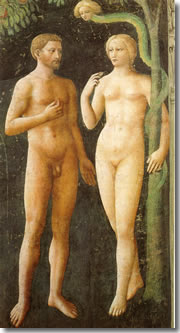
The myth of
the “female temptress” also influenced the character of Armide. Women’s sexuality was wrong and depraved,
whereas men’s was celebrated. (This is
an attitude that still persists today – a woman is a “slut” but a man is a
“stud”.) Sexual women were feared – they
could lead a man astray, strip him of his virility, take away his agency. Armide takes this to the extreme – she can
stop whole armies with her beauty!
Having her compel Renaud to love her against his will definitely plays
into this fear as well.
Basically,
the taboo against female sexuality is a taboo against female power. In 1600s European society, women had very
little power – they were under the control of either their husband or father. But the one thing you can’t take from a woman
is her body – hence the fear of her using it to control men.
But in
reality, “sexual power” is not power at all.
Yes, Armide is defeating armies – but she isn’t actually DOING anything. She’s not fighting in the field or casting
lethal spells against them. She’s merely
an object to distract them. You might as
well say a rabbit hole has power if you catch your foot in it.
Another belief
present in Armide is that women are
slaves to their emotions. While it is
true that women tend to be more emotional than men, they were often viewed as
entirely irrational and incapable of objectivity. In fact, the modern word “hysteria” comes
from the Greek word for womb, and the idea of the “wandering womb” causing
emotional distress in women was influential in medicine for centuries.
And this
concept is very much reinforced by Armide’s actions. First she hates Renaud, then she loves him –
then she forgets she’s AT WAR; more specifically, that she’s at war with him! If we had a male protagonist, it’s unlikely
that he would desert his post to pursue an enemy girl.
Skip to the
end of the opera – the once-strong sorceress, desperate for Renaud to love her,
humiliates herself and begs him to take her as his captive. “I will take blows/Destined for you,” she
cries, willing to change sides for a man who isn’t even interested. It’s quite clear that the librettist had very
strong opinions on women’s fickleness!
Armide begs Renaud to take her prisoner.
This last
part makes me think of another point – that of male dominance and female
submission. The Church has long preached
male headship within a marriage and family (I actually had an argument over
this a few months ago with a friend from church!) and that women really WANT to
submit. It’s a very clever way of
reinforcing power imbalances – it’s for your own good, after all – and that obviously
influences Armide’s plea at the end.
So even
though we have a “strong” female character, who exerts a lot of agency compared
to real women of the period, much of Armide
is inspired nonetheless by misogynistic beliefs.

No comments:
Post a Comment